How Do You Upload Things Into Audacity
Note that Scribl is a participant in the Amazon Associates Program, an affiliate advert program. That means that Scribl can earn fees if you purchase anything later following these links. This helps us promote all our authors' books and continue to provide complimentary titles to our customers at our expense. If you are considering ownership anything you see listed here, please consider following our link when you practise.
File Processing with Brazenness
Whether you've recorded your file with Audacity and saved information technology as a projection (Audacity projects finish in .AUP in Windows) or are importing a WAV file from the Zoom, the steps to normalize the audio for distribution and consign to MP3 are the aforementioned.
While this guide doesn't encompass everything that Audacity can do, if you worked through all of the steps under Getting Everything Ready to Record with Audacity and Recording with Audacity and you complete this section, you will have gained a good working knowledge of the program. These may appear complicated, but once y'all're familiar with this, and if you have a modern computer, the whole procedure should only accept about a infinitesimal per file of your time, plus maybe another infinitesimal or two (depending on the length of your capacity) exporting the file to MP3. If yous have a newer reckoner with an SSD drive, that will noticeably speed things up.
-
From Audacity, select File -> Open up…, or Printing Ctrl-O. Browse to the file you desire open up, and open it as you would any other file. (You lot tin also correct click on nearly audio files, including AUP, MP3, and WAV, and select "Open with," then select Audacity, to open them directly from Explorer).
-
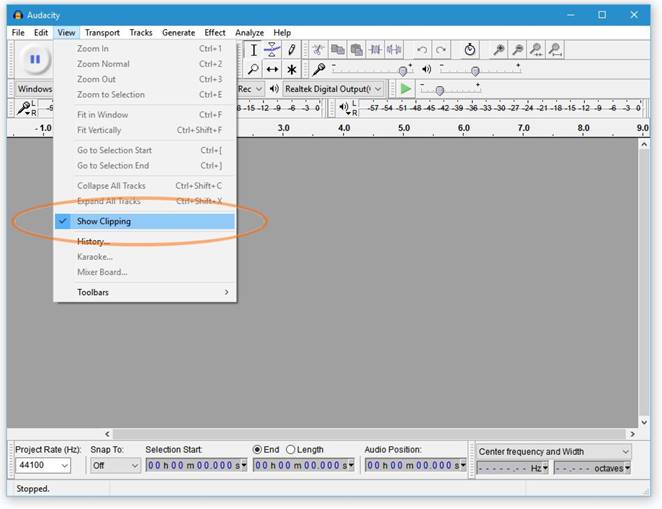
Make sure that Audacity is set up to prove you clipping in your audio. This is when your recording was too loud and the sound has been "clipped" to fit within the volume capacity of a digital player. Under the View menu, select "Testify Clipping." Clipping occurs when you record at too high a level. In Audacity, clipping occurs every time the Recording Level meter shows the audio volume into the crimson all the way upwardly to 0dB.
-
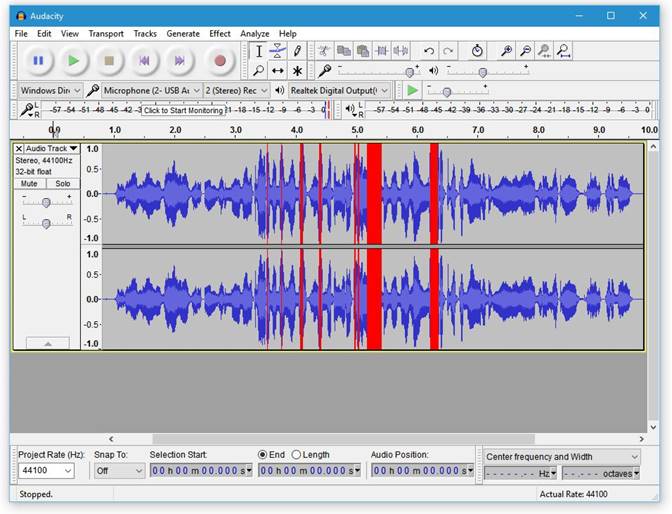
Confirm there is no clipping. There should exist no carmine lines on your audio rails. If at that place are single extremely narrow brief red lines, this could be OK, but if possible to re-record, that'due south the best fashion to ensure you get good results in your final file. If there are more than a few clipping lines or a thick clipping bar, every bit shown in the instance here, you must re-record the sound.
-
To save the file with a new name, click on File -> Salve project equally…, perhaps adding a word that reminds you, similar EDITS, to the first or stop of the filename. If Audacity includes .AUP at the terminate (don't worry if it doesn't, merely depends on your Bone settings), be sure y'all don't remove information technology. It is very of import that you not overwrite the original file. You lot'll need the original in case you ever need to go dorsum and make different changes in the future. It is impossible to disengage changes after closing Audacity.
-
While yous tin't undo any changes after you close Audacity, if you e'er want to undo your latest change(s) inside an open session of Audacity, you tin can select Edit -> Undo or press Ctrl-Z.
-
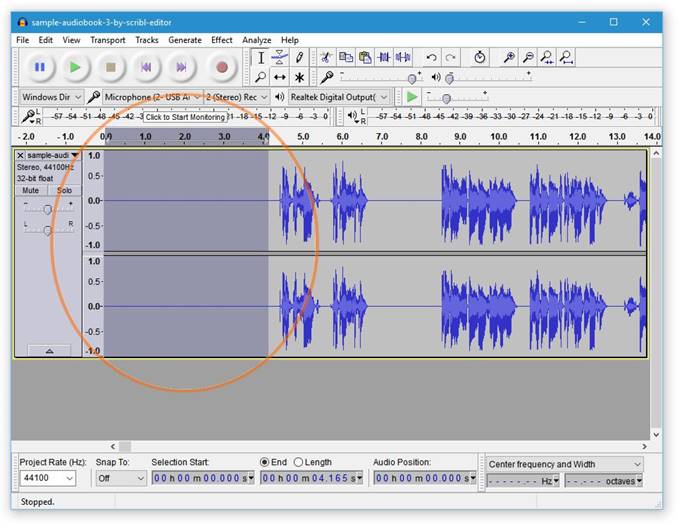
In that location must be about 2 seconds of tranquility (no talking) recorded. This will permit Audacity understand the noise we want to remove. Note that this will only piece of work for a steady dissonance, similar the electronic racket from your computer or amp or the audio of air coming out of a heater or air conditioner. If it's something else, similar a dog barking, a jackhammer drilling or car honking outside your window, then you lot'll demand to re-record those sections.
-
Select the silence.
-
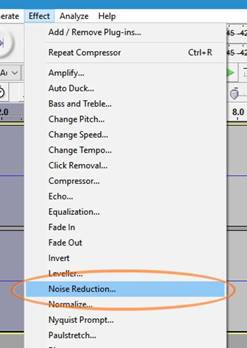
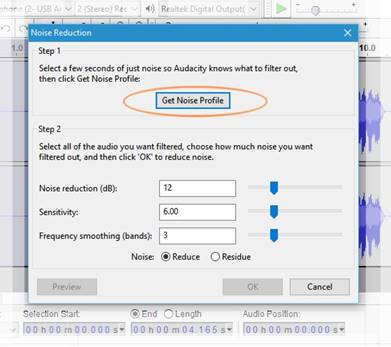
Click on Effect and then Noise Reduction…
-
Bank check that the numbers match those in the figure below. Click "Get Noise Contour." Audacity now understands the groundwork noise that it needs to remove from the entire file.
-
Press Ctrl-A to select the entire track.
-
Select Effect -> Noise Reduction again
-
This time, click OK to remove the noise profile you selected before from the unabridged track
-
Press Ctrl-A or click in a blank area to the left of the sound track to select the entire track. The selected region should darken, indicating it is selected.
-
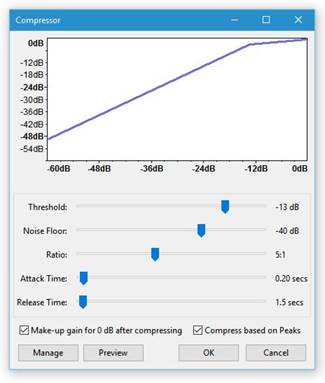
Click on Event -> Compressor... Change your settings if needed so the numbers on the right friction match the image below. Be sure both boxes at the bottom of the window are checked.
-
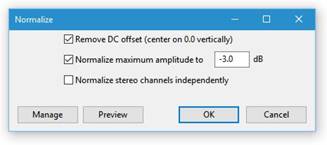
So, to set your audio to the right maximum volume level beneath the maximum Acme Volume, click on Consequence -> Normalize… Employ these settings to make sure the sound falls below the maximum commanded book. If yous observe that your submission is rejected every bit having a peak volume that is likewise loud, and so effort going back to the original file and re-running, replacing the recommended "Normalize maximum amplitude to" of -iii.0dB with something lower, like -three.5dB. Use the aforementioned value here for all parts of your audiobook, or the volume will noticeably change between them.
-
To export your file to MP3, select File -> Export Audio… Scan to the location y'all want to salve the file. Under "Save equally type:" select MP3 Files. Set the "Bit Charge per unit Manner" to Constant, the "Quality" to 192kbps, and the "Channel Mode" to Joint Stereo. Gear up the file name, if you want to change it and hit Relieve.
-
The Edit Metadata window will pop up. The merely Tag here that matters is the Runway Number. You must fix this for each track, except for the Intro and Outro, so nosotros know the social club your files go. Even if your book is a single affiliate, yous must set the Rail Number to 1. Keep in listen that there tin can exist only one chapter per runway, simply there can be more than than 1 track per chapter. If a affiliate is longer than 100 minutes, and so divide it into two or more shorter tracks. Note that you can also set the Metadata as part of the Brazenness Project file earlier exporting to MP3, if you wish. To do this, select File -> Edit Metadata… before exporting to MP3.
Click to enlarge
Click to enlarge
Caution: NEVER OVERWRITE THE ORIGINAL FILE WHEN MAKING CHANGES. ALWAYS Work ON A COPY.
The 3 audio quality attributes that we exam for when y'all upload a file are: Average Volume, Peak Volume, and Dissonance Floor. The following steps will optimize your audio quality and maximize your chances at achieving the target values for Average Volume, Peak Book, and Racket Floor.
Delight sympathize that the following approaches only work if your starting file has expert dynamic range of at least 35db (the deviation betwixt the loud and quiet parts of the audio).
Ideally, before you perform any adjustments, your placidity areas should be beneath -54dB and your louder parts consistently reaching above -12dB. That would provide a dynamic range of 42dB (the difference between -54dB and -12dB), which is good. The lower the levels for the repose parts and the higher the levels for the louder parts the better, only exist careful your loud parts don't peg the meter to 0dB, because that will cause clipping. Setting the correct recording levels to optimize this is covered in more than detail at Setting Recording Levels in Audacity.
If your Dynamic Range is less than 35dB, then You lot MUST RE-RECORD. Earlier recording, exist sure y'all have followed the setup steps at Setting Recording Levels in Brazenness. If yous are struggling to become past this step, contact authorsupport@scribl.com and provide as much detail as you tin near what's happening for you.
To perfect your audio, we will now perform 3 steps, which must be performed in this order: Racket Reduction, and then amplitude Pinch (not to be confused with file size compression), and finally Normalization.
Noise Reduction
Click to overstate
Click to enlarge
Click to enlarge
Compressor
Click to enlarge
Advanced Processing Option
Note that there is some other Compressor plugin available that often produces superior results, only it requires more than work. If interested, check out Chris' Dynamics Compressor. Especially if you take a difficult time getting into compliance on the volume and racket floor settings, you may notice that this advanced choice is your salvation.
Normalize
Click to enlarge
Consign track to MP3
At this signal, you can upload your files to Scribl, just we recommend you also add together a foursquare cover image to each MP3 file (run across beneath). In either case, be sure your files meet the other requirements for length and ID3 tagging as explained in our Audiobook File Requirements.
Adding a custom cover to MP3 files with Mp3tag
Scribl will catechumen your ebook cover to an MP3 comprehend for you lot if yous don't provide one, but considering a volume embrace is rectangular and an audiobook comprehend is foursquare and much smaller, nosotros don't recommend this. Instead, using whatever approach you used to create your ebook encompass, make a foursquare version that is readable at 300 pixels 10 300 pixels. This is much smaller than the ebook cover, which is at to the lowest degree 1680 pixels x 2520 pixels. Because of the smaller size, you may desire to remove some of the text and/or make the principal words, like the title, larger. If the narrator is different from the writer, you should also include the narrator's name on the cover, where you would non on the ebook.
At this point, nosotros assume yous've already installed Mp3tag. If not, delight follow the instructions at Downloading and Installing the Recording Software.
Of import: The cover must not be also pocket-size or too large. It must exist 300 x 300 pixels, which is the same as 3.125" 10 3.125" at 96dpi.
With your cover ready, do the following to embed it in your MP3 files using Mp3tag:
-
Navigate to the folder that has all the MP3 files in information technology for your audiobook.
-
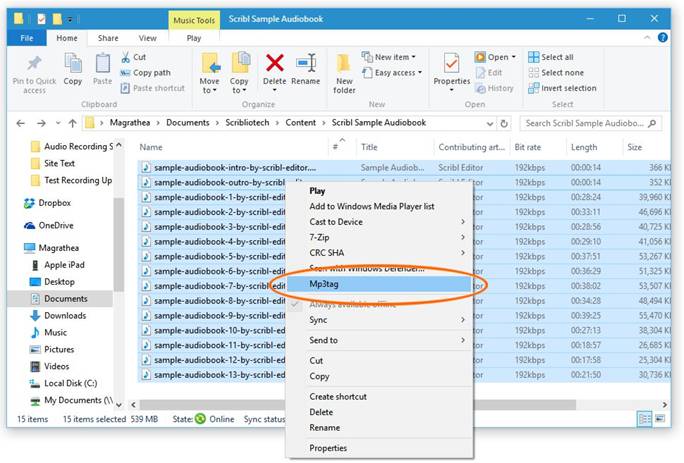
Select all of the MP3 files (and nil else) for your audiobook.
-
Right-click on the selected files and select Mp3tag
-
Mp3tag will open with all of your MP3 files
-
Inside Mp3tag, select all of the MP3 files you lot just opened
-
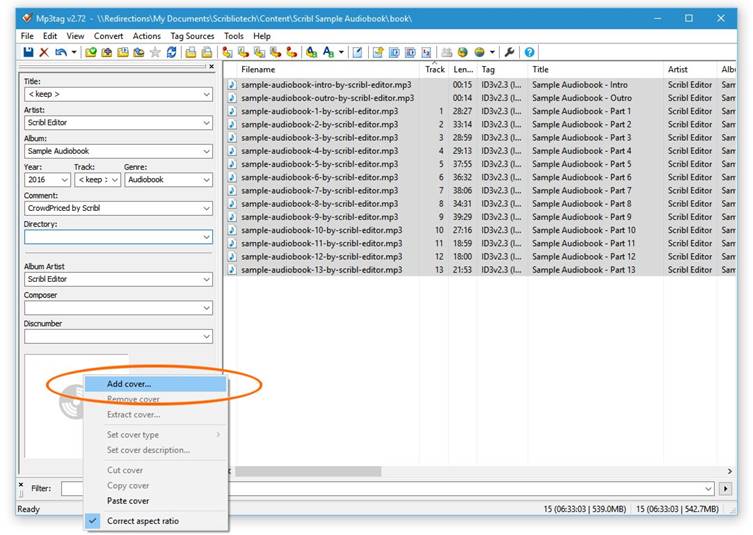
Right-click the square box with the icon of the CD in the lower left corner of the data Tag Panel on the left and select "Add together Comprehend…" (You may need to scroll downwards in the Tag Panel to see it if your window doesn't show everything you see in the image below. If you don't see the Tag Panel for some reason, first enable it on the View bill of fare or press Ctrl-Q.)
-
Browse to where you saved your cover and select Open
-
Click File, then "Save tag" or press the Salvage icon in the toolbar
-
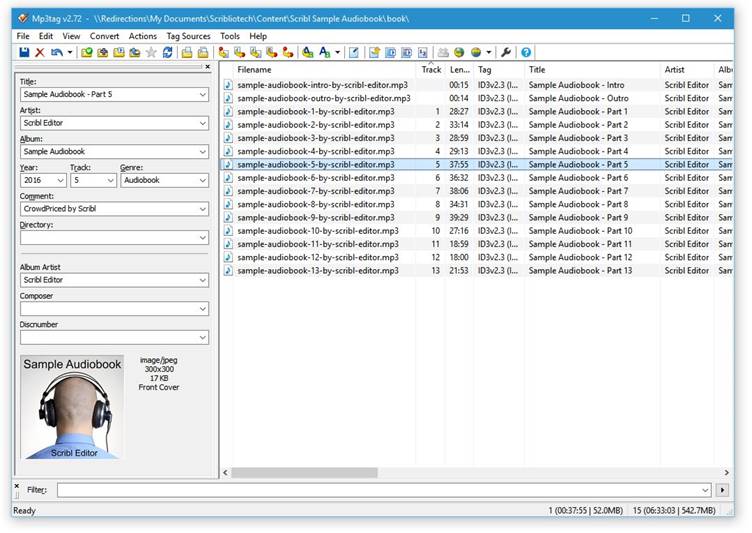
Click each individual file in the list to be sure the embrace image appears in the Tag Panel where the CD icon had been.
-
This is also a good time to exist sure that the track # is right for each file. The other fields will exist overwritten by Scribl, so it doesn't really thing what values you set in other fields other than the Track # and comprehend image.
Click to enlarge
Click to enlarge
Click to overstate
Upload your Files
You are at present ready to upload your files to Scribl. Be sure your files meet the other requirements in our Audiobook File Requirements and follow the instructions on the Audiobook page of the Publish process.
Source: https://scribl.com/guides/how-to-record-an-audiobook/audio-file-processing-with-audacity
0 Response to "How Do You Upload Things Into Audacity"
Post a Comment